You’re crushing it at the gym. You’re hitting your protein goals, drinking enough water to sink a ship, and pushing through those brutal last reps. But when you look in the mirror, your progress seems… stalled.
Sound familiar?
If you’re doing everything right in the weight room and the kitchen but still aren’t seeing the gains you want, you’re likely missing the most crucial ingredient in the fitness recipe: Sleep.
Here is a hard truth that every gym-goer needs to hear: You do not build muscle while you are lifting weights. You build muscle when you are resting.
Let’s break down exactly why sleep is the ultimate muscle builder, what happens when you skip it, and most importantly, how you can hack your routine to get the best rest of your life.
The Science of Sleep and Muscle Growth (Simplified)
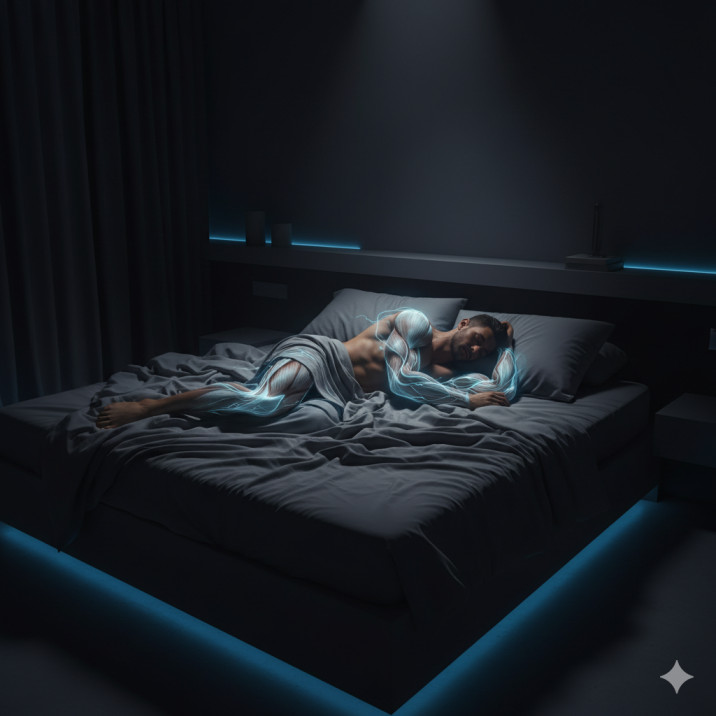
When you lift heavy weights, you aren’t actually growing your muscles—you’re tearing them down. You’re creating microscopic tears in your muscle fibers. It’s the healing of these tears that makes your muscles bigger and stronger.
And guess when 90% of that healing happens? Yep. When you’re dreaming. Here is what is happening under the hood while you snooze:
1. The HGH Magic Trick
Human Growth Hormone (HGH) is arguably the most critical compound your body produces for muscle repair and fat burning. Think of it as your body’s natural, legal performance enhancer. During the deep stages of sleep (specifically Stage 3 non-REM sleep), your pituitary gland releases a massive surge of HGH. If you cut your sleep short, you literally rob yourself of this free muscle-building hormone.
2. Muscle Protein Synthesis Hits Peak Levels
Protein synthesis is the biological process where your body uses the protein you ate during the day to repair muscle damage. While you sleep, your body requires significantly less energy for basic functions (like walking, talking, and thinking), so it redirects all that saved energy straight into protein synthesis.
3. Cortisol Control
Cortisol is the stress hormone. In small bursts, it’s fine. But chronically high cortisol levels? That’s the ultimate “gain-goblin.” High cortisol breaks down muscle tissue for energy and encourages your body to store belly fat. Good sleep crushes cortisol levels, protecting your hard-earned muscle.
What Happens When You Don’t Sleep Enough?
Let’s say you decide to survive on 5 hours of sleep so you can wake up at 4:30 AM to hit the gym. You might feel hardcore, but your body is actually fighting against you.
- You lose muscle, not fat: A study by the Annals of Internal Medicine found that when people on a calorie deficit slept only 5.5 hours a night, 60% of their weight loss came from muscle. When they slept 8.5 hours, 50% of the weight loss came from fat.
- Your workouts suffer: Sleep deprivation tanks your glycogen stores. This means you’ll gas out faster, lift lighter, and have terrible stamina.
- Injury risk skyrockets: Being tired affects your central nervous system, leading to poor form, slower reaction times, and an incredibly high risk of tweaking a back or blowing out a knee.
How Much Sleep Do You Really Need?
For the average sedentary adult, 7 hours might cut it. But you aren’t average. If you are actively lifting weights, doing CrossFit, or training for a sport, your body has entirely different recovery demands.
Athletes and heavy lifters should aim for 7 to 9 hours of high-quality sleep per night. If you had a particularly brutal leg day, leaning closer to 9 hours is incredibly beneficial.
5 Ways to Hack Your Sleep for Maximum Gains
Okay, so you know why you need sleep. But if you’re tossing and turning every night, simply knowing the facts doesn’t help. Here are five actionable, human-tested ways to get more (and better) sleep tonight.
1. Turn Your Bedroom into a Batcave
Your body relies on temperature and light to know it’s time to shut down. Drop the temperature in your room to around 65°F to 68°F (18°C – 20°C). Buy blackout curtains or use a high-quality sleep mask. If your room is cool and pitch black, your brain will naturally start producing melatonin.
2. Break Up With Your Screen
We all love a good late-night doom-scroll, but the blue light from your phone mimics sunlight, tricking your brain into thinking it’s high noon. Try to put your phone on the charger across the room at least 45 minutes before bed. Read a physical book instead.
3. The 2 PM Caffeine Cutoff
Pre-workout is great, but caffeine has a half-life of about 5 to 6 hours. That means if you scoop your pre-workout at 5 PM, half of that caffeine is still raging through your bloodstream at 11 PM. Keep your heavy stimulants in the morning or early afternoon.
4. Leverage “The Nightcap” Supplements
If you need a little help winding down, skip the alcohol (which absolutely ruins deep REM sleep) and opt for natural sleep aids. Magnesium Glycinate is a game-changer for relaxing the nervous system and easing muscle cramps. Chamomile tea and Tart Cherry juice (which is packed with natural melatonin) are also fantastic pre-bed options.
5. Be Boring (Set a Routine)
Your circadian rhythm loves consistency. Going to bed at 10 PM on weekdays and 2 AM on weekends throws your internal clock into chaos. Try to go to bed and wake up within the same 30-minute window every day—even on your rest days.
The Bottom Line
Working out is the spark, nutrition is the fuel, but sleep is the fire.
If you’re serious about building muscle, getting stronger, or leaning out, you have to treat your sleep with the exact same intensity that you treat your gym sessions. Stop wearing sleep deprivation like a badge of honor. Get to bed, catch some Z’s, and let your body do the heavy lifting while you dream.
What’s your biggest struggle when it comes to getting enough sleep? Drop a comment below and let’s talk about it!